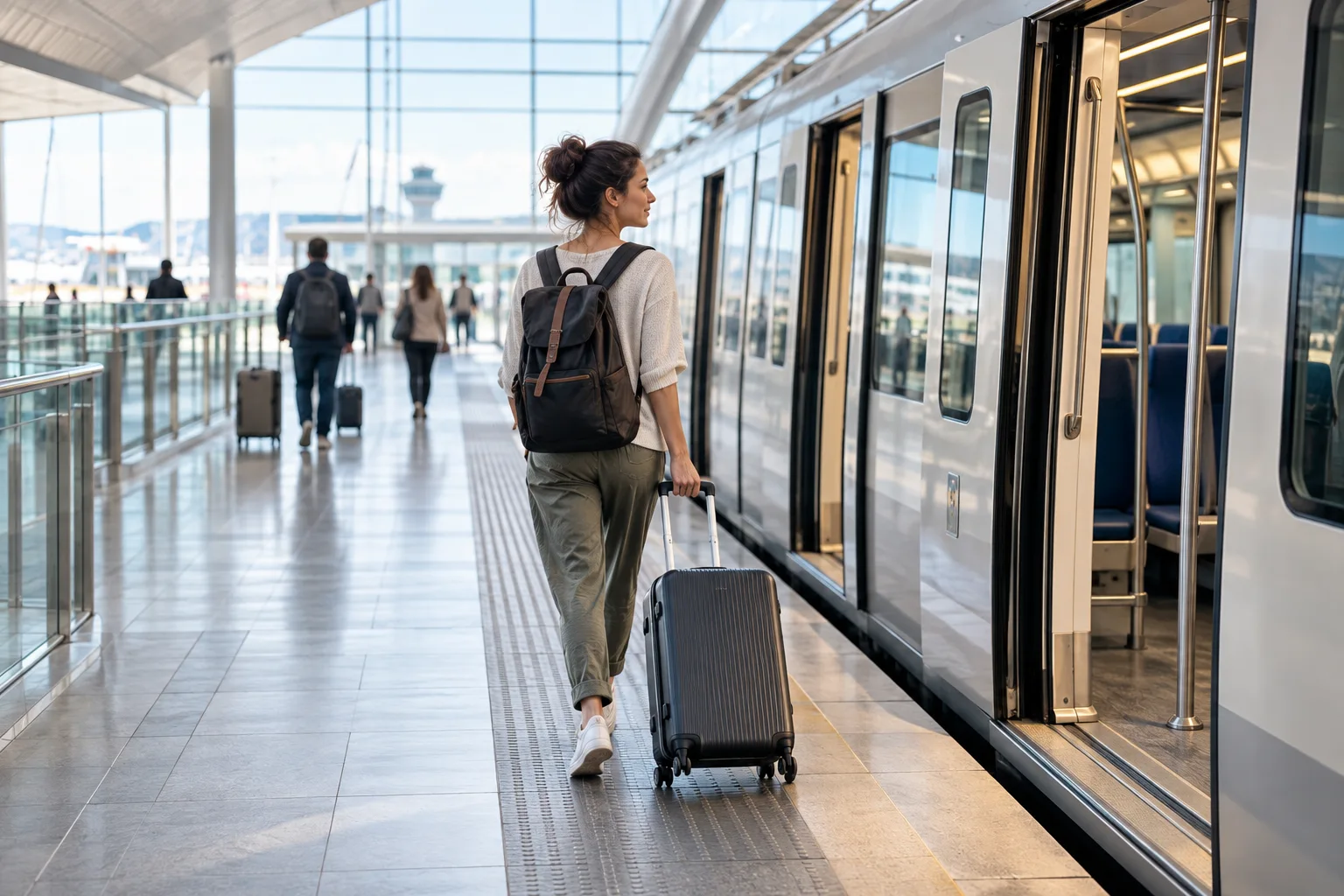
The journey from the field ends at the hotel door. This is the starting point that should be maintained when comparing a high-speed train to a private bus or bus. The time of arrival at a central station is only part of the way; after it there may be an additional line, walking with luggage or waiting. On the other hand, direct travel by car can be affected by road congestion.
First write down the exact hotel address and terminal. Add the number of passengers, type of luggage and need instead of a cart or other equipment. If there is a mobility limit, check the entire travel sequence a departure, replacement, departure and the way to the hotel. General information about line accessibility is not an answer to every possible route.
Now compare two alternatives that come to the same address and the same time window. Check rates on the operator's website and conditions in the transport offer, without relying on a price you found in an old guide. The cost of a train per person should be doubled in the number of relevant passengers, after checking age conditions and tickets. For a ride offer only add additions that actually apply to your vehicle.
| Question | Public Transport | Shuttle or taxi |
|---|---|---|
| When do we go out? | Hours of service and frequency on arrival | Rendezvous time, wait and late policy |
| How many passes? | Lines, docks and walking segments | Location of collection and whether the service is direct |
| How much cargo? | The operator's rules and ability to carry it | Order-approved capacity |
| What's the total price? | All tickets and the last section | Car price and relevant add-ons |
| What happens in disruption? | An alternative to the line that stopped working | Through Contact and Conditions of Change |
Heathrow demonstrates why choosing a service name is not enough. The field site shows several ways to get to central London, including rails and road transport. The appropriate option depends on the destination in the city, so a hotel near a certain station may lead to a different choice from a hotel far away from it.
The official TfL page on the Elizabeth line contains information on arrival from Heathrow, accessibility and cargo. Use such a page to verify the relevant segment for your route, and then also check the way from the destination station to the hotel. Don't draw from the airport station's accessibility that any follow-up segment is equally convenient.
A useful exercise is to write the way as a series of actions: exiting the arrivals hall, arriving at the station or vehicle, traveling, switching if required and reaching the door. At each stage, they wrote down who was carrying what. Two adults with a small bag organize differently from a family with some luggage and a stroller. It is not necessary to give comfort a uniform price; it is enough to understand what is required of you at every option.
On a late landing, check for an alternative that does not depend on the last link of the day. Do not break the time of landing as the time of boarding the train: between the two there is an arrival process whose length is not guaranteed. On the ride, find out what information is being given about the flight, what is included in the wait and how to communicate if arrival time changes.
It is also advisable to check the accommodation between the hotel and transportation before booking accommodation. Sometimes two hotels at the same price create a very different ride from the field and back. Mark the station exit you will be using on the map, not just the name of the station. Ask the hotel for an explanation of the appropriate entrance if the address is large or includes several buildings. This way, you can decide if adding to another location saves you from an organization that burdens you.
You should also plan your trip back at the comparison stage. An early departure time or hotel at another address may make the choice in the opposite direction. You can choose a train on arrival and a ride back if it fits the plan. Keep on the phone the address, the pick-up instructions, and the alternative you checked; this is how the decision is made before meeting the luggage in the arrivals hall.
Planning the meeting moment and the final segment
In an invited ride, keep meeting instructions that can be understood even after a long flight. A general name of an area is not always sufficient. Find out how the service provider is identified, who they turn to if they can't find it and what they do if the departure from the terminal is delayed. Don't settle for a phone number without knowing which way it's available to you.
In public transportation, check out how to purchase the right ticket for the route, and not just its price. If a network connection or a particular payment method is needed, prepare an alternative according to the operator's official information. There is no need to pre-purchase a product that you are unsure of; the goal is to come up with an understanding of the process.
Add to the travel chain the entrance to the accommodation. In an apartment or hotel with special arrival instructions, make sure they are available at the time when you are expected to arrive. The road from the field does not end with a street drop if you still need to figure out how to get a key. The arrival coordination is performed in front of the accommodation, according to your order.
On the day of departure, the route was re-ran. The number of passengers may be the same, but the time, the location of the pick-up and the cargo can be different. Save the address of the drop point required for your flight. Traveling back that was convenient is not proof that the same choice is also appropriate to return.
Activities discussed in this guide
For Prague, compare arrival and departure transfers separately. Confirm whether pricing is per vehicle or per person, luggage allowance, waiting time and address coverage. The two links cover opposite directions.
Affiliate links: we may earn a commission at no extra cost to you. Booking and payment take place on Viator. Check dates, terms and the final total.
Example scenario: Check the selection before committing
Two passengers choose a train that reaches a convenient station, but the hotel is on another side of a large complex. Instead of just planning train time, they check the exit and walk with the luggage. In the second alternative the transport arrives at the address, but the meeting point must be coordinated in the field. Both options can work; the comparison should include the parts between the journeys themselves.
Work Questions and Practical Answers
| Decision Point | What to ask | How to Advance |
|---|---|---|
| Pickup ID | How do you identify the vehicle or person and what do you do if you don't meet? | Keep the meeting instructions and how to contact along with the invitation. Check what to do if departure from the terminal is delayed according to the conditions you have received. |
| Purchase a ticket | What do you need to buy the right ticket for the course? | Check in advance the purchase process and the appropriate payment method. The goal is to understand the steps, not to buy a ticket that you are not sure is right for the track. |
| Receiving the room | Are there instructions for entry or coordination at the time of arrival? | Prepare the receipt or entry instructions next to the property address. Getting to the right street does not end the route if more coordination is needed to get the key. |
| The reverse direction | What details change on the way from the hotel to the airport? | Re-register the time, terminal and pick-up point on return. It is not necessary to use the same means in both directions if the needs or windows of time are different. |
Worksheet for travel that can be done door-to-door
Write the route as a chain, from the point where passengers and cargo are to the place where they want to finish. For each step, add travel means, required action, and information that needs to be available. If there is a passage between toilets, give it its own line. So waiting, walking, or handling luggage does not disappear in a single travel time.
Prepare two versions for the same sequence: the preferred option and a reasonable alternative that you are willing to use. It is not necessary to plan every possible event. Check mainly where the program depends on hard time, information not yet received or a single service. Any such dependence should be given a clear answer before departure, or remain marked as open clarification.
Divide the roles between the passengers according to the composition: who handles the addresses, who holds the clearance and who leads the cargo. When one person does everything, check to see if more time is needed. Keep the list together with the service documents, and update it if you change a hotel, hour, or number of passengers. A short and up-to-date plan is more useful than a detailed page based on an order that has already changed.