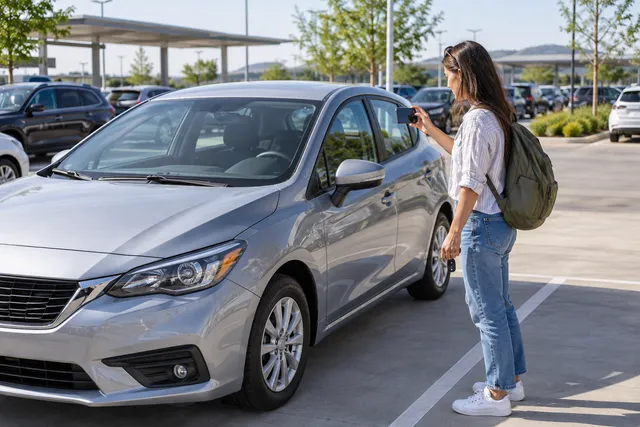
A rental car gives flexibility, but its daily price is not the cost of vacation transportation. Fuel or charge should be added, parking, tolls and additions required for ordering. On the other side, the price of transportation from the airport is also not the whole picture: you may need taxis, trains, or a day trip. The decision depends on the journeys you make in practice.
Start from the vacation board with no means of transportation. Each day list where you sleep, where you want to go, and how many people participate. Mark mandatory travel separately from ideas you might make. This way a car doesn't become cheap on paper just because you added five day trips to it that you didn't really want to do.
Now they've built two full alternatives. In the car alternative, put a price on the exact order, equipment you need, expected parking and road costs. In the alternative the shuttles put a transfer in both directions, daily transport and special trips. Check whether the fare is for a car or a person, and how many passengers and luggage are included. It's a small mistake that can reverse the outcome.
| Component in Calculation | With a car | Without a car |
|---|---|---|
| Arriving from the field and returning | Collection, driving and return | Transport, train or combination |
| Days of stay in the same place | Renting and parking without even traveling | Transport only if required |
| Day Trip | Fuel, Parking and Fees | Tickets, a ride or an organized trip |
| Another passenger. | Adjustment to vehicle capacity | Additional price if the payment per person |
| Change Course | Checking rental limits | Check availability and replacement cost |
Computational example only: Suppose a vehicle for the entire vacation, including the fixed expenses you estimated, costs 420 units of currency. Transfers and basic transportation without a vehicle cost 180. Each day an additional trip costs 30 by car or 90 in the appropriate alternative. The fixed cost gap is 240, and the savings per day trip is 60. The equinox is accepted on four days of travel: 240 divided by 60. These are not market prices.
The exercise only works if the assumptions are correct. If an organized trip also includes guidance or entry that the vehicle does not include, the same service should be added to the side of the vehicle or explain that these are different experiences. If the day of the trip requires a larger vehicle for the entire week, the fixed cost varies. And if there is no public alternative that fits the route, one is not invented just to complete a table.
The return route is also important. Europcar offers a rental where one place is collected and returned to another, but notes that the cost and limitations depend on the places of collection and return. Therefore, compare an offer that embodies your route, rather than a base price for return at the same branch.
The road costs use the local source. In Austria, for example, ASFINAG's official toll planner matches to toll products on track, noting that it does not include toll products in other countries. A cross-border route therefore requires further testing.
Add a sensitivity test to the table: What happens if you give up one day of your trip, or if the price of parking is higher than the estimate? There is no need to guess an extreme scenario. Change one assumption at a time and see if the choice is reversed. If the two options remain close, it does not mean much to declare that one "pays more" based on a rough calculation. In such a case time, comfort and preference to drive are a key part of the decision.
Finally, check for a third alternative: ride only for part of the vacation. You can start with a few days in the city and compare car pickup on the day you leave it. The account can be changed because of a short rental price, the location of the branch and the way to it. Write alongside the price also how much tampering each alternative requires. Choose the one that fits the plan and the passengers, and update the calculation when the route or vehicle changes.
The flexibility of a vehicle also depends on the division of roles.
Before deciding by money, write down who wants to drive and who is willing to manage the navigation and stops. If only one person drives the entire vacation, the comfort of the others rests on their job. This conversation doesn't change the rental price, but it can change the number of car days you really want.
Check whether the vehicle will stand unused for some days. An urban day with paid parking can look different from the day you go out to a few focal points. Comparison by daily average blurs the difference. Mark days that benefit from flexibility and days when the car is mostly waiting for you.
In the transportation alternative, find out if it is possible to change the return time and under what conditions. A service with a fixed hour can be very convenient if it matches the plan, but is not the same product as a vehicle that stays with you. Conversely, traveling where no one on the team should be driving can be a significant personal advantage. Write the advantage next to the price and not inside it.
When choosing a vehicle for some of the days, check out the two additional transfers that are generated: arriving at the branch and returning from it. Add pick-up and return time to the calendar. A mixed option is good when it simplifies the actual fare, and not just when the rental fee amount seems smaller.
Activities discussed in this guide
Test a car-free plan using a defined service: a Prague airport transfer or a Paphos cruise with pickup. Choose your relevant destination and compare with car rental, parking and fuel together. One service will not cover every journey during the holiday.
Affiliate links: we may earn a commission at no extra cost to you. Booking and payment take place on Viator. Check dates, terms and the final total.
Example scenario: Check the selection before committing
A group plans four days in the city and two days outside it. A vehicle for the entire period may give a sense of flexibility, but in the first four days it requires parking and does not serve the route. Compare an alternative where a vehicle is picked up just before departure, including the way to the branch. If the collection is very cumbersome, the complete solution may still be appropriate; the question is decided by the entire sequence.
Work Questions and Practical Answers
| Decision Point | What to ask | How to Advance |
|---|---|---|
| Responsibility for driving | Who is driving and how many days is he interested in doing so? | Ask drivers about the desired driving scope, not just the ability to drive. Their preference is part of the shared vacation and is not an unlimited resource of the group. |
| Days without use | What days does the car stand and where will it park? | Mark days when no trip is planned and check the relevant parking. If the vehicle is standing most of the time, it is best to at least calculate the possibility of a partial rental. |
| Flexibility in transportation | Is the time of return constant and what does change mean? | Read how the time of return is determined and what can be changed according to the proposal. Don't compare timed service to an independent vehicle as if both give the same flexibility. |
| Partial Collection | What other trips are created when you rent only for part of the vacation? | Add the way to and from the branch and the delivery operations. Savings in rents should be examined alongside the time and costs incurred in replacing the means of transportation. |
Worksheet for travel that can be done door-to-door
Write the route as a chain, from the point where passengers and cargo are to the place where they want to finish. For each step, add travel means, required action, and information that needs to be available. If there is a passage between toilets, give it its own line. So waiting, walking, or handling luggage does not disappear in a single travel time.
Prepare two versions for the same sequence: the preferred option and a reasonable alternative that you are willing to use. It is not necessary to plan every possible event. Check mainly where the program depends on hard time, information not yet received or a single service. Any such dependence should be given a clear answer before departure, or remain marked as open clarification.
Divide the roles between the passengers according to the composition: who handles the addresses, who holds the clearance and who leads the cargo. When one person does everything, check to see if more time is needed. Keep the list together with the service documents, and update it if you change a hotel, hour, or number of passengers. A short and up-to-date plan is more useful than a detailed page based on an order that has already changed.