Four days in Budapest makes it possible to build a trip with one major area each day. The next route is a four-day planning proposal that is useful in the city, rather than a guarantee of opening hours or ticket availability. If the arrival is late or the flight back is early, make the first or last day a short version. Check the activity times after selecting dates and before buying entries.
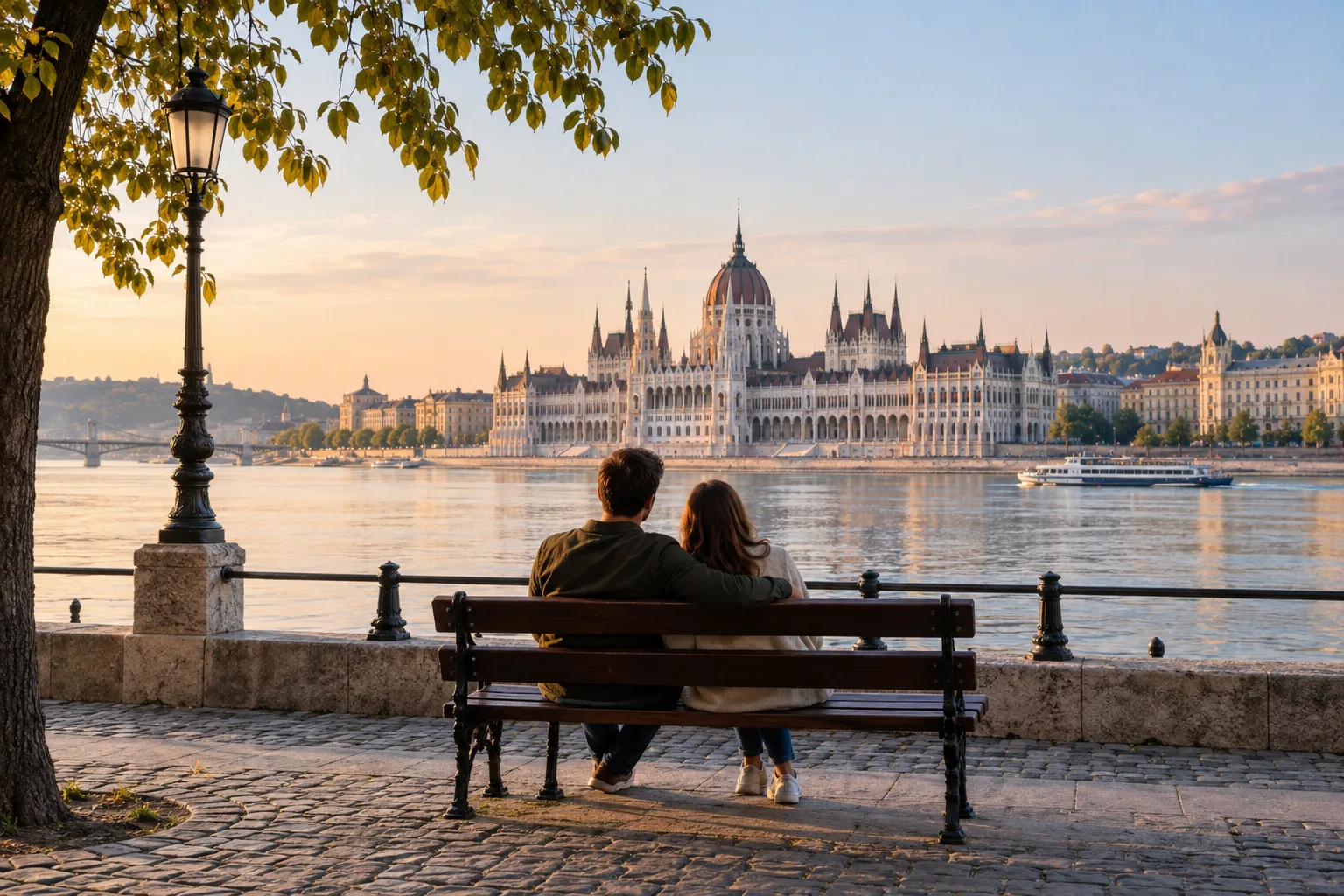
On the first day, they started on the Pest side and chose a simple introduction to the city centre and the Danube bank. The goal is to understand the distances from the hotel, find a useful transport station and get used to the pace. It is possible to make do with walking by the river and the outward appearance of Parliament. A visit inside a building is a separate decision that requires an invitation check; it is not a "small stop" that is added without time.
Next to Parliament it is worthwhile to dwell on the structure itself: the faade draws from the Gothic style, while the plan also combines Baroque and Renaissance influences. The central dome and the two symmetrical wings express the historical structure of the Hungarian parliament, in which two houses operated. This gives a reason to look beyond the size of the building and look for its symmetry. The next day, on the other side of the river, you will be able to re-identify the structure within the Pasht skyline.
On the second day, the central part of the day was dedicated to the Castle Quarter in Buda. In the area are the Royal Palace, the Matthias Church and the Fisherman’s Bastion. Choose what you want to see on the inside and what on the outside, rather than pre-acquire any option. Adjust the way up and down for your walking ability, and plan a break before moving to another part of the city. If there is any strength left in the evening, go back to the place you loved on the first day.
The Fisherman’s Bastion is also interesting because of the gap between its appearance and its age: the now familiar structure was designed in the late nineteenth and early twentieth centuries on the basis of the previous fortification system. The arches and towers make observation part of architecture. The nearby Matthias Church adds another story: Inside the building you can find the symbol of King Matthias, whose name is associated with the church. Those who enter receive a historical continuation of the exterior appearance, and not just another photographic point.
On the third day, they chose the municipal park and its surroundings. This is the appropriate day to leave flexibility: a trip between open spaces can be extended if moving, or replaced by a cultural institution that interests you if conditions change. Don't automatically add another museum just because it's nearby. Geographical proximity does not make two long-term activities short.
A walk in the park can be given two tangible anchors: the Vidhuniad Castle, which houses the Museum of Agriculture, and the Museum of Fine Arts in the vicinity of the park. Art lovers can dedicate the internal visit to the other; those who prefer to stay outdoors can build the morning around the castle and park structure.
On the fourth day, leave room for the island of Margit, or return to an area you didn't get to enjoy. The island is one of the city's green recreational areas. Its choice is suitable for those who want a calm ending; those who prefer food, shopping, or art can change the day without changing the previous three days. If it's the day of the flight, limit the activity to something that's easy to finish on time.
| Day | Program Anchor | Possible addition | What not to pre-determine |
|---|---|---|---|
| 1 | Pest and Danube Center | One visit invited | Sequence of entries after landing |
| 2 | Castle Quarter in Buda | One internal site | Paid activity immediately after the drop |
| 3 | Municipal Park | Museum by Interest | Some long attractions that morning |
| 4 | Margit Island or Completion | A meal in a favorite area | Remote departure prior to return flight |
To select a hotel, open the four-day map and check out two sample trips: to the second day's epicenter and on the way to the airport. Sometimes a hotel that is not adjacent to the famous site will be comfortable thanks to proper transport. Also check the way from the station to the door with luggage and the environment you want to return to at night.
Before purchasing a city ticket, only the sites you decided to enter were written down. Compare the separate cost to the ticket cost and the conditions of inclusion, validity and booking. A site that is only on the list because it is included is not a savings if it is pushing activity you wanted more. The calculation can also be started without a card and without making a decision at that moment.
Leave one window every day that has no role. It will absorb a long meal, rain, turn or simply a desire to stay in a pleasant place. A successful city trip does not require filling every hour; it requires that the things you care about get enough time and that you do not spend most of the day on the way to them.
Sources for the facts of the destination: Budapest Info Castle Quarter; Budapest Info Central Sites; Budapest Info Margit Island in the Spring; Visit Hungary Parliament; Institute for Historical Research Fisherman’s Bastion; Institute for Historical Research Matthias Church; Liget Budapest Park Institutions. The order of days, the pace and the choice of anchors are an original systemic proposal.
Turning four-day course into a program that can be changed
After choosing an anchor for each day in Budapest, prepare for it three versions: full day, half day and almost no walk. The same list of places should not appear in all versions. On the day of the castle district, for example, decide what part is really important to you and what can be left for the next time. Thus fatigue does not require inventing a new route in the middle of the street.
Keep orders by day and not just by service type. Inside the day folder, write down the exact login address, the time to which you were invited, and the way of arrival from the previous activity. The name of a large complex is not enough when one needs to find a register, a particular entrance or a meeting point. Someone else in the group needs to know where the information is stored in case the central phone is not available.
A food break has a role to play in the course. Decide which area you want to eat in, but leave more than one option suitable for your vehicle. An invitation to a faraway restaurant can turn the whole morning into a race back. When the meal itself is a key part of the experience, build a day around it instead of adding it at the end to a crowded program.
It is also possible to spend time observing that does not require a ticket. Choose one building and pay attention to its shape, materials, and the relationship between it and the street. Compare the sight of the river from two points during the trip. This gives walking a purpose even to those who do not want another museum, without presenting it as a cheap substitute for an activity they are not interested in.
When traveling with children, give them a small task that can be completed on the way: choose an architectural detail for the painting or find a pleasant place for a break. Avoid competition that requires more points. In adults with different interests, a similar thing can be done by making a substitutionary choice of one stop each day.
At the end of the second day, check the remaining plan against the actual pace. If the first two days required more rest than expected, remove activity from the third day before buying another entry. An updated plan is not a failure; it is the use of information you have already accumulated in the city.
On a four-day vacation you can also leave one morning uninvited. Choose it after you have arranged the activities that depend on regular hours. Thus there is a window to completion that you really wanted, and it is not necessary to invent a new activity. If there is no need for completion, it is used to rest or return to the place you loved.
Activities discussed in this guide
A relaxed Budapest itinerary can include a daytime or evening cruise instead of another long walk. Choose around daylight, dinner and the journey to the pier. Compare departure times and inclusions rather than starting prices alone.
Affiliate links: we may earn a commission at no extra cost to you. Booking and payment take place on Viator. Check dates, terms and the final total.
Example scenario: Check the selection before committing
Suppose you planned a visit to Buda, a meal in Pest and an extra activity with a fixed hour. The first visit is extended and you are still enjoying it. If the last activity is flexible, leave room for dinner and travel. If it is not flexible, it is best to shorten the first part or move it to another day. Write down which choice you would prefer to make before paying, rather than when the clock is already pressing.
Work Questions and Practical Answers
| Decision Point | What to ask | How to Advance |
|---|---|---|
| Three versions per day | What is left of the daily anchor if you are only comfortable traveling for half a day? | Select one central component each day and keep a shortened version next to it. This way you can download the add-ons without giving up the experience that you chose in the same area. |
| Access to Information | Can another passenger also find the booking and entry point? | Keep a proper copy of the activity details with another person as well. Check that he knows the day, time, and entry without going through the entire travel folder. |
| Dinner at the track | Is the food place completing the route or forcing to cross the city? | Choose a meal area that is in the natural continuation of the walk. If the meal is a destination in itself, give it a defined window and reduce other activity around it. |
| Update after two days | What activity can be removed without harming the most important thing on vacation? | Mark one permission activity for the third day and one for the fourth. If the pace is slower than the planning, remove them before touching the central bookings or while resting. |
Worksheet for individual program selection
Open two pages, one for each alternative you are considering. On each page, write down where you sleep, what the main morning is, where you intend to eat, and how you return at the end of the day. Mark the things that have not yet been checked with a color or a fixed word, so that they do not mix with decisions that can already be relied upon. In the first stage there is no need to order anything.
Now select one detail that changes between the options and pass it through all day. Another accommodation location may change the morning and evening; longer activity may move the meal and the way back. Update the implications before adding another idea to the list. Thus the comparison remains between two possible vacations, rather than between two wish lists.
Finally, let each passenger read the day and mark one moment that they are expecting and one moment that may be cumbersome. Try to solve the difficulty without removing everything that is important to another person. Keep a full version and a short version of the program, and return to them after checking hours and services for dates you have chosen.