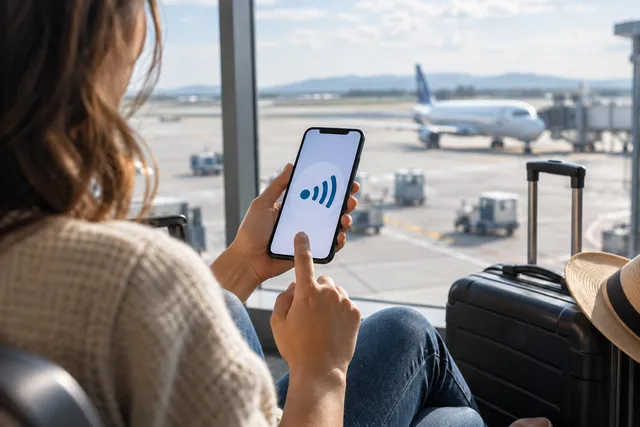
One browsing package for the whole family sounds economical, but it requires that the devices be close to the device that shares the connection. If one of the passengers goes out to buy food and another stays at the hotel, needs change. Therefore the first question is not how many phones there are, but how many separate groups there will be during the day and who in each group needs an independent connection.
A hotspot uses the cellular connection of one device and allows other devices to connect to it. Apple makes it clear that the feature depends on the operator's support, and that the number of devices that can be connected simultaneously depends on both the operator and the model. This should be checked in the device and package you select before basing the entire family plan on.
Three possible structures
| Arrange Connection | When is it best to check it? | What should be considered |
|---|---|---|
| One package and sharing | Everyone travels together and most of the use is short | Dependence on one device and its proximity |
| A package for each user | Divide often or use a lot at the same time | More purchases and settings to manage |
| Two Independent Connections and Sharing to Others | The family is divided into two permanent groups. | You need to know who is joining each team. |
You don't need to buy a package for every device just because you can. A tablet primarily used in a hotel does not necessarily need an independent connection. On the other hand, a phone for someone navigating a separate group plays a different role. Write next to each device what it should do outside: map, messages, cards, video or work. This compares needs, rather than counting screens.
Compares total price and dependencies
Ask for a bid for at least two alternatives: a shared package that supports sharing and a few smaller packages. Make sure these are the same countries and the same days of validity. Do not automatically share family consumption equally; those who upload videos may use a different type of message than those who check messages. Your invoice example should reflect the actual distribution of usage.
Airalo notes that a hot spot can be used with eSIM when the device and network support it, and turns to testing the terms of the package. The practical meaning is that one should not choose according to eSIM only. Make sure sharing is allowed and supported by the particular product and that all connected device consumption is included in your estimate.
Consider the daily care as well. Who carries the sharing device, who is responsible for loading it, and how do you know how much data is left? If every port needs to renew a connection to three devices, another package may justify the cost for you. You can choose two independent connections for both adults, and share the others as needed, if appropriate for family composition and supplier conditions.
Make a brief attempt with a hot spot at home to learn the operation of the devices, without pre-activating a travel package whose validity begins with installation. Experience teaches how to connect; it does not prove that the future package will support sharing or that the reception at the destination will be good. These two questions are examined separately.
It is also advisable to agree on which uses are made through the shared package. For example, the family may decide that large updates and uploading photo albums will wait for a suitable connection at the accommodation, while maps and messages are available during the day. It's a way to design a common resource. If this consent is not appropriate to passenger habits, one can simply include the heavy uses of the estimate or select independent packages and reduce the need for coordination.
Keep a copy of the hotel address, arrival instructions, and tickets in each group planning to separate. Even those who choose separate packages do not have to rely on an available connection at any moment. Choose the connection structure according to the way you intend to travel, and then adjust volume and validity. This makes it easier to know what to pay for and where a simple sharing will suffice.
Plan communication for each group that separates during the day
Draw the division of the family on a normal day: who goes out first, who stays in the room and who may part ways for a short purchase. Each group should have basic information accessible, even if you don't buy a package for each person. The number of independent groups may be a more useful measure than the number of phones you bring.
Determine where the shared tickets are and how to get to them when splitting up. If only one phone contains all orders, separate packages do not resolve this dependence. Keep appropriate copies in a place that is accessible to anyone who needs them, without sharing personal information that is not necessary for planning.
In an alternative of connection sharing, decide who handles activation and loading. Check that the practical use is appropriate for the person carrying the device. If he wants to go for a walk while the others stay, the structure may need to be changed and not just increase the volume.
It is also possible to plan a day with less digital use. A brief summary of an address, meeting point and time reduces the need for continuous messaging. This is not a substitute for age-appropriate coordination and composition, but rather a way of managing a day when it is not necessary for every individual to depend on an active connection at every moment.
Example scenario: Check the selection before committing
Two adults and children split into two activities. If the whole connection stays with one group, the other needs a suitable solution or a program that does not rely on continuous browsing. Comparing two independent connections to a common alternative, including the terms of doubt and habits. The decision is not that every child needs a package; it is that each group will have the information and context required for the day you planned.
Work Questions and Practical Answers
| Decision Point | What to ask | How to Advance |
|---|---|---|
| Independent Groups | How many groups may be in different places at the same time? | Diagram the planned splits, even if they are short. Each group needs a solution for information and communication as needed, and not necessarily a package for each device. |
| Tickets and Orders | Does each group have the information it needs to present? | Transfer to each group only the required documents and make them accessible. An independent connection does not solve a situation in which all cards remain on a different phone. |
| Device Warranty | Who carries and loads the shared device throughout the day? | Agree on who runs the sharing and how the device's availability is maintained. If the role limits the same person throughout the day, check another connection structure. |
| Meeting without messages | Have a place and time been set that can be understood even without a network? | Choose a clear meeting point and an agreed time depending on the composition and ages. The planning reduces dependence on consecutive messages and does not replace the escort and supervision rules you have established. |
A worksheet for purchase suitable for your use
Before adding a product to an order, write down what action it should help and what days you will use it. Then write down what you already have and what is included in another product purchased. This step prevents duplication and clarifies whether you need a new solution or just an organization of the existing things.
Compare two options according to the same usage. Specify the number of relevant passengers or devices, the period of use, and the limitations you have read in the offer. Don't give an automatic advantage to the larger package; check which additional component will really change the day. If the advantage is convenience and not saving money, you can choose it, but it is worth writing it explicitly.
Choose one reasonable change in the plan and think about how it affects the purchase: an activity that cancels, a split of the group or a need that grows. Check the course of action according to the product conditions, without assuming that it is possible to return, expand or transfer it to another. Keep the certificate and instructions of use in an accessible place. Thus the product remains a tool that serves the trip, rather than a commitment that changes the entire vacation.