The duration of the vacation alone does not determine how much baggage is needed. Three nights with light clothing are different from a weekend where you need warm clothing, extra shoes or activity equipment. Start with the list of things you will actually use, and only then choose the bag and the baggage supplement. The tagline "boarding suitcase" in the store does not guarantee a match for the flight you ordered.
There are three categories to separate: a small personal item, a bag or a trolley into the cabin, and a suitcase delivered to the belly of the plane. Eligibility for each depends on the card and the company. For example, Lufthansa separates on its official page between tariffs and routes with different eligibility for hand luggage. Check the specific order and the company that operates each segment.
Choose by use, then measure
| Option | When might it fit? | The central compromise |
|---|---|---|
| Small personal item | Few clothes, little equipment and no planned shopping | Limited volume and less convenient access when full |
| Trolley or Bag for the Passenger Cabin | Want more volume without a delivered suitcase | You have to make sure that it is included and meets the limits |
| Suitcase delivered | Volumetric equipment, how many passengers or a defined need | Possible cost and handling of delivery and collection |
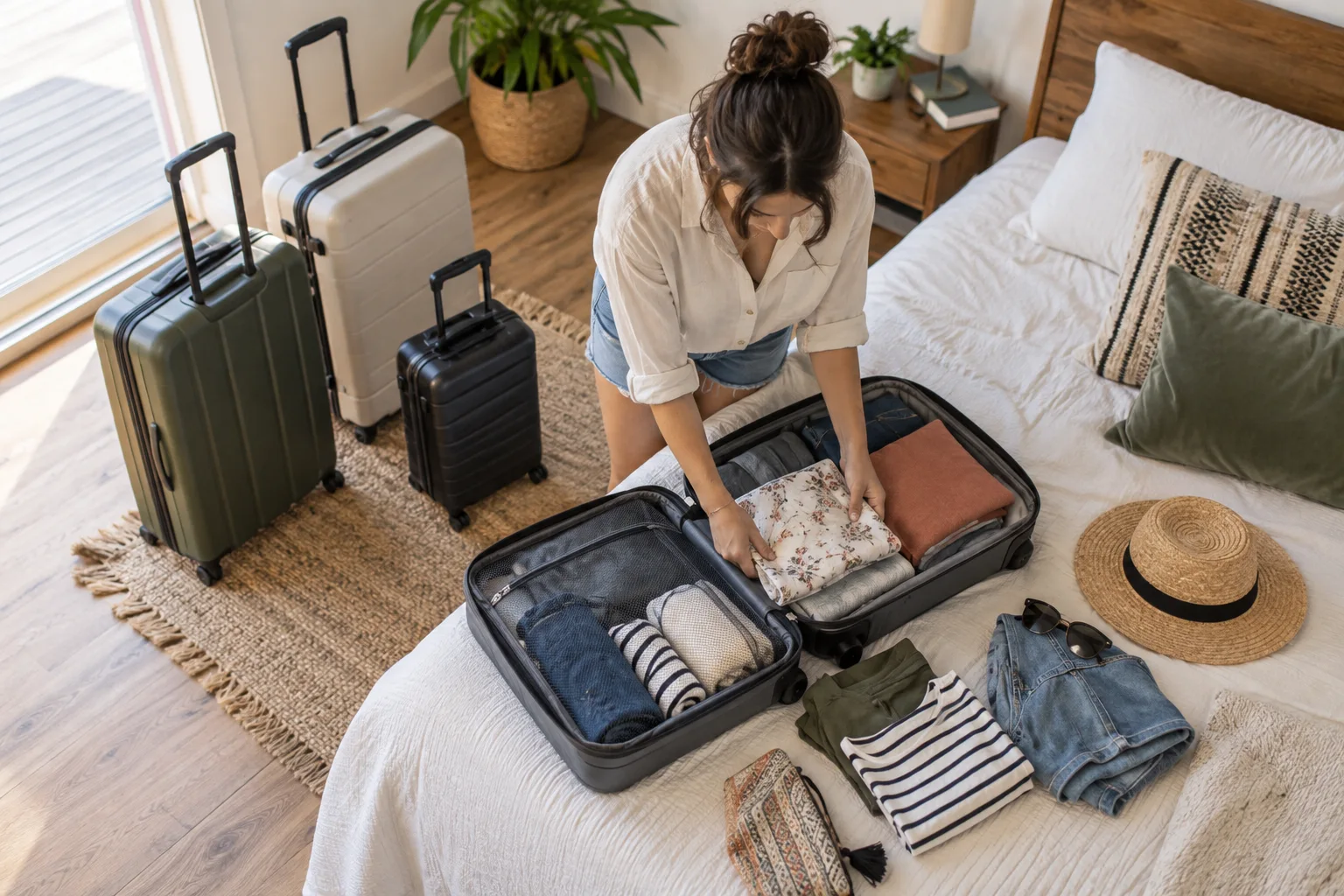
Spread things out on a surface and split into five groups: clothing, shoes, bathing, electronics, and equipment dedicated to the activity. Next to each item ask what day or use it is intended for. An item that has no answer does not have to disappear from the list, but it is worth understanding how much volume it occupies compared to the chance that you will use it. Start by downloading duplicates, such as unnecessary charges or some items that play the same role.
Don't design a packaging that fills the bag to the limit already on the exit. Clothes that are conveniently packed at home do not always come back in the same order, and you may want to add a small purchase. If you are planning to do laundry, check that there is a practical way to do it at a suitable time. Don't base limited packaging on a service you haven't checked or on hours you don't want to spend on vacation.
Checking the luggage in both directions
Sizes and weights are not uniform between companies. EasyJet, for example, separately lists a small bag and a large bag, and clarifies that the dimensions include handles and wheels. Use the company page and booking details to measure your bag; there is not one size that automatically fits every flight.
On the individual flight chart, each segment was registered with the operating company, the tariff, the included item and the purchased supplement. Do so also come back, especially if the tickets are different. If you share a suitcase between several passengers, make sure it is associated with the right booking and passenger, and do not assume that weight limitations can be consolidated without the company's explicit approval.
Compare the price of the ticket with the baggage you really need. A cheaper offer at the start of the search may receive an add-on that will change the comparison. On the other hand, there is no need to upgrade an entire rate if a targeted add-on meets the need for a suitable price. Calculate both directions, and the difference between pre-purchase and subsequent addition according to the conditions shown.
Also think about the road from the field to the lodging place. A bag that is easy to pick up may be suitable for many passes, while a trolley can be convenient for those who prefer to roll the gear most of the way. There is no uniform solution: check who is able to carry each bag, whether there are stairs on the way and what you will need to pull out while traveling. A place that is accessible to documents and items that are used along the way can be more useful than another pocket that you won't use.
The day before departure, pack the actual bag, measure and consider it, and recheck the company's instructions about the items you chose to take. Special equipment requires its own inspection. The good honor decision is the one that allows you to take what is needed, comfortably move around and know in advance what is included in the price.
A brief recap of the day with the bag packed.
After everything goes into the bag, go through the expected actions along the way: lifting, a short walk, getting a document out and opening a necessary cell. A closed case is not necessarily an easy one to use. If each cargo is required to disassemble half a suitcase, change the order before departure and not at the station.
Choose clothes according to combinations rather than separate stacks. You can deploy several dress systems and see which items fill more than one role. Do not take out an item that is required for a specified activity just to get to a small case; start with duplicate items that have no planned use.
On a family trip, decide who holds what and what things you need while on the road. Don't load up on one person all the things that are needed for everyone if it makes it difficult to get around. It is possible to arrange an accessible case for the things in common, depending on the baggage limitations and what anyone is capable of carrying.
We also planned the packaging back. Leave a way to separate worn clothes and items that need to be accessible on the last day. If shopping is planned, take them into account as part of the bag and luggage purchased. It is not necessary to add a suitcase just as a general option, but it is also not advisable to assume that a place will be found without checking.
At the end of the pack, take a picture of the final list. On the next vacation you can check what was used by you and what was left in the bag unused, instead of starting again from a general equipment list that does not fit your habits.
Example scenario: Check the selection before committing
A passenger manages to pack everything in a trolley, but the travel documents and phone charger are at the bottom. A short return home she discovers that any use will require a full opening. A long-standing order change accessible within the ordering framework solves the problem without increasing the amount of equipment. The example shows that sometimes the important packaging decision is accessibility, not the number of items you have managed to compress.
Work Questions and Practical Answers
| Decision Point | What to ask | How to Advance |
|---|---|---|
| President's Check | Is it possible to pick up and comfortably lead the bag in the planned way? | Try carrying and a short movement with the bag packed according to your ability. A home use test can reveal a difficulty that is not only evident in measurement and weight. |
| Access at the time of way | What to pull out without opening the whole suitcase? | Concentrate the necessary items on the road in an accessible place. If any access requires opening everything, change the order before adding another bag to the list. |
| Duplicates | What items play the same role and don't need all of them? | Attach to each planned use item and check to see if another item fills it. Start by reducing duplications rather than giving up equipment required for the activity you have chosen. |
| Packing Back | Where will there be room for the things you've been wearing and shopping for? | Prepare a way to separate items that have been worn and return equipment in a simple order. Leave room for shopping that you have planned within the baggage frame and not on the basis of a general discount. |
A worksheet for purchase suitable for your use
Before adding a product to an order, write down what action it should help and what days you will use it. Then write down what you already have and what is included in another product purchased. This step prevents duplication and clarifies whether you need a new solution or just an organization of the existing things.
Compare two options according to the same usage. Specify the number of relevant passengers or devices, the period of use, and the limitations you have read in the offer. Don't give an automatic advantage to the larger package; check which additional component will really change the day. If the advantage is convenience and not saving money, you can choose it, but it is worth writing it explicitly.
Choose one reasonable change in the plan and think about how it affects the purchase: an activity that cancels, a split of the group or a need that grows. Check the course of action according to the product conditions, without assuming that it is possible to return, expand or transfer it to another. Keep the certificate and instructions of use in an accessible place. Thus the product remains a tool that serves the trip, rather than a commitment that changes the entire vacation.