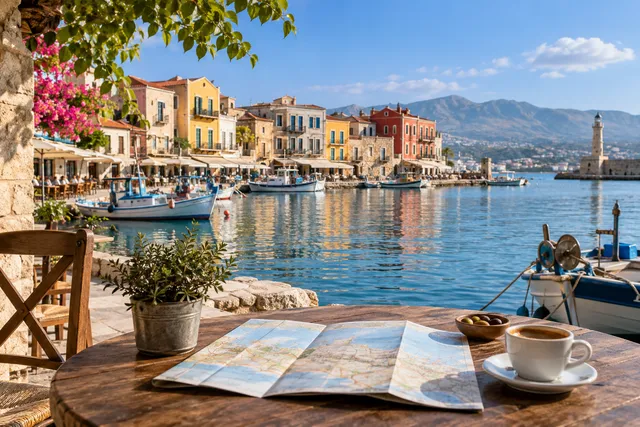
When planning a trip by car, it is easy to add another town and another vantage point. On the map the distances seem small, but the day off also includes meals, parking, room reception and time where you arrived. The good plan is the one that leaves time for the experience you're on your way to.
Start with just three anchors: places or activities that really matter to you. Mark them on a map, along with the possible airports. It was only later that secondary ideas were added. If already at this stage the anchors are far apart, choose whether to extend the vacation, reduce the area, or give up one of them. A cheap hotel in the middle of the map does not necessarily solve long trips in any direction.
Now group the places by area and check out two accommodation plans: one base for a few day trips, or two bases with one pass. Each program recorded the estimated driving time each day and the number of times it was repackaged. Use route times for the relevant roads and re-evaluate near-travel; aerial distance is not a sufficient tool.
| Decision | One Accommodation Base | Some basic lodging |
|---|---|---|
| Organized | Dissolve once | Packing and re-applying |
| Distant routes | Coming back the same way or close to her | You can go along the route. |
| Change of plan | It is easy to move days around the same hotel | We must consider the nights already booked. |
| An Evening on Vacation | You know the local environment. | Meet different areas |
| An important test | Time accumulates back and forth | Transition time plus stops and accommodation |
The decision can be practiced in invented numbers: suppose base A takes two hours each way for two days of travel, i.e. eight hours in total. Passing base B may reduce travel, but adds transit, packing, and room acceptance. Think of all the steps before deciding that the extra hotel "saves a day." The numbers are a planning exercise, not an evaluation for a particular geographic orbit.
Divide each day into three blocks: transition, activity, and stops. Determine for yourself how long a trip is suitable for your vehicle, then see if there is enough time left for the activity. A long transit day is sometimes suitable for one central stop; you don't have to add three more sites to it just because they look close to the road. Leave a simple option to shorten the day.
On a trip to Austria you can use ASFINAG's information to check travel routes and traffic status. The official app also concentrates information on rest, parking and loading areas. These are details that help turn a map line into a day that can be done, especially when there are regular stops that are important to travelers.
When a route includes moving to another country, check the conditions of the vehicle before booking for overnight stays. Europcar explains that the possibility of crossing a border depends on the country of rental, the type of vehicle and the countries in which you travel, and may require proper approval and package. The exact booking conditions determine what can be done on your route.
Each candidate accommodation has added three simple tests: where to park, how to unload the luggage and where to eat after arrival. A centrally visible location on the map may require walking from the parking lot, and an isolated location may require other planning for dinner. These details are verified in front of the accommodation. They are not a reason to automatically disqualify a hotel; they help figure out what each evening will require of you after the day of the trip.
Before a final invitation, go over the first and last night. On the day of arrival, leave room for the vehicle collection process and arrival at the hotel; on the day of return check the way to the branch and the field. Add to each base a short local plan for a day when you want to travel less. Each day stands on its own, you can enjoy the route and also change it without feeling that the entire trip depends on the exact power.
Choosing a lodging base is also a choice in the way you pack
When the trip includes several overnights, each pass adds actions that do not appear while traveling on the map: collecting objects, checking the room, loading and regrouping. Write down how many passes you are willing to make calmly. If the list exceeds this number, try to unify two nights before giving up an important site.
Check the direction of each day and not just the distance. A base that is close on the map to two areas does not necessarily create a convenient travel sequence. Draw the route from the accommodation to the activity and back, distinguishing between a circular day and a day that ends close to the next base. A transit day can work well when it integrates in the direction of the trip rather than adding back and forth.
Decide in advance what remains in the vehicle during the day and what should be accessible. There's no need to take out every case at every stop. On the other hand, don't build activity on the assumption that there will be a cargo storage solution that you haven't tested. We planned the arrival at the accommodation and the handling of the equipment according to the information you received from it.
On a group vacation, check who enjoys the ride and who sees it as just a way to get there. A sequence of scenic points may be part of the experience for the driver or passengers, but not for everyone. You can choose one scenic day and a relaxed local day instead of scattering a lot of seemingly short trips every day.
Activities discussed in this guide
Before changing accommodation bases, consider a day trip instead: the Dolomites from Venice or the Blue Lagoon from Paphos. Match it to your itinerary and budget for the full outing time. Do not assume pickup from every hotel.
Affiliate links: we may earn a commission at no extra cost to you. Booking and payment take place on Viator. Check dates, terms and the final total.
Example scenario: Check the selection before committing
For exercise, a course includes a new night each day to be close to the morning point. Try a two-night alternative at the same base and add the extra way to the activity. Compare it to the time of packaging and placement saved. There is no predetermined result: if the extra route is large, the passage may fit; if it is small, a regular base can simplify the trip.
Work Questions and Practical Answers
| Decision Point | What to ask | How to Advance |
|---|---|---|
| Number of Passes | How many times do you want to repack during your vacation? | Count nights and packing operations separately. A few short nights in different places can require more organization than you would like, even if the journeys themselves are short. |
| Direction of route | Is the day circular or naturally moving to the next base? | Draw the direction of the day and see if the move to the next lodging fits in. Sometimes another base shortens back and sometimes it only adds baggage handling. |
| Cargo handling | Where is the equipment at the time of transit day? | Select the option to deposit or store the equipment in the relevant location. Don't add a long day's visit on the assumption that the cargo will work itself out. |
| Passenger Preferences | Is the road itself a desirable part of the recreation for everyone? | Ask each passenger to describe a pleasant day. The differences will help to choose between a concentrated travel day and a few short departures from a regular base. |
Worksheet for travel that can be done door-to-door
Write the route as a chain, from the point where passengers and cargo are to the place where they want to finish. For each step, add travel means, required action, and information that needs to be available. If there is a passage between toilets, give it its own line. So waiting, walking, or handling luggage does not disappear in a single travel time.
Prepare two versions for the same sequence: the preferred option and a reasonable alternative that you are willing to use. It is not necessary to plan every possible event. Check mainly where the program depends on hard time, information not yet received or a single service. Any such dependence should be given a clear answer before departure, or remain marked as open clarification.
Divide the roles between the passengers according to the composition: who handles the addresses, who holds the clearance and who leads the cargo. When one person does everything, check to see if more time is needed. Keep the list together with the service documents, and update it if you change a hotel, hour, or number of passengers. A short and up-to-date plan is more useful than a detailed page based on an order that has already changed.