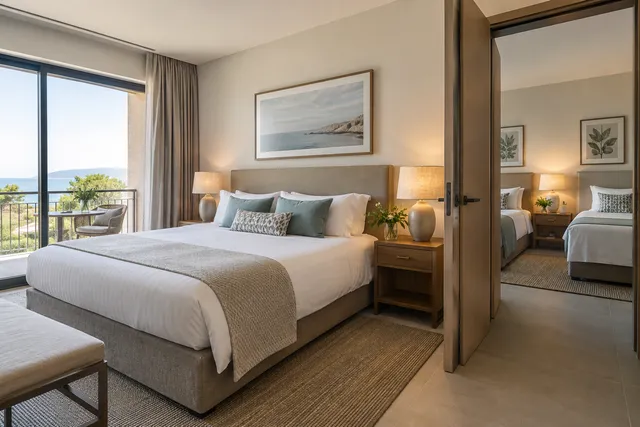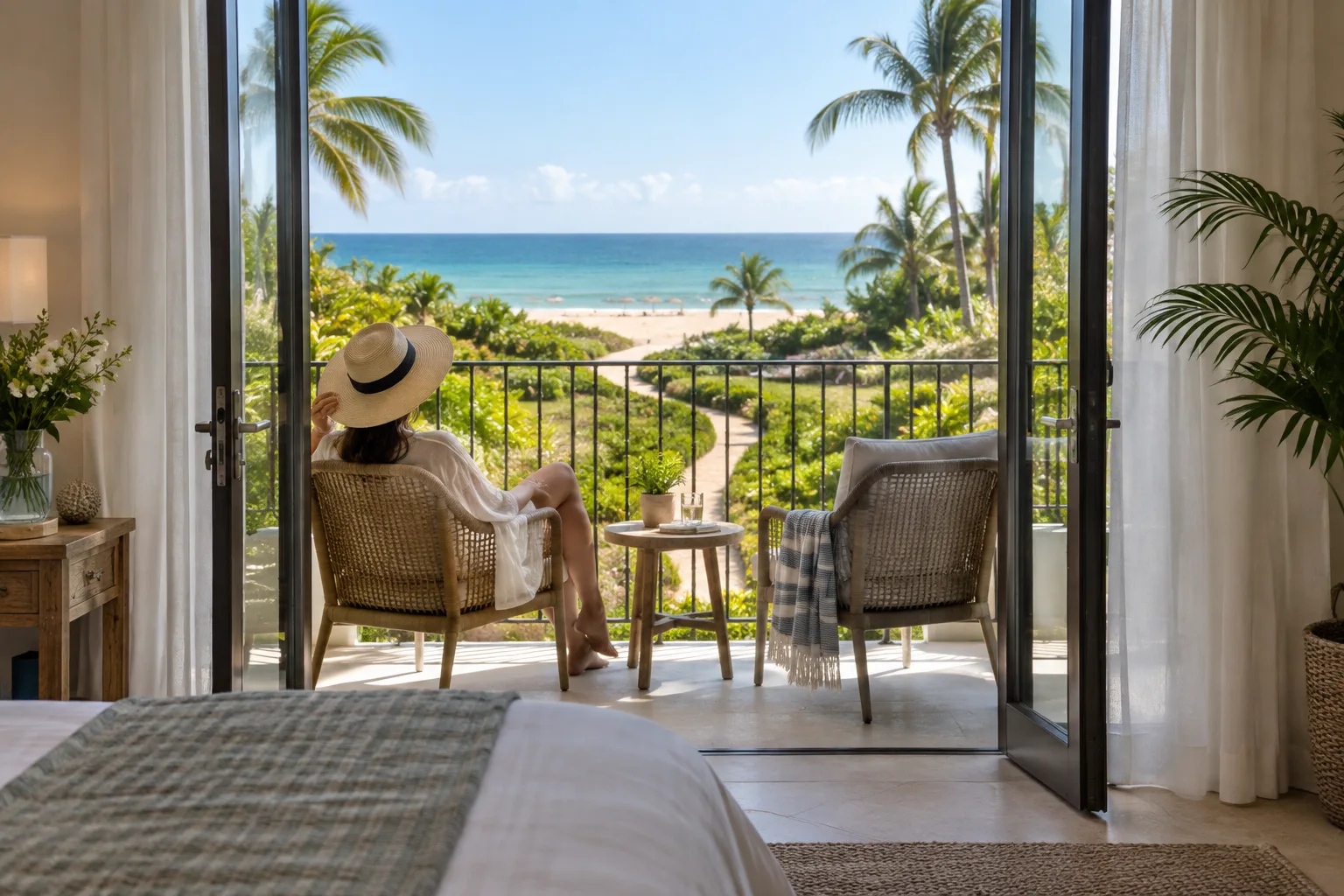
A room with a sea view, a hotel near the beach and a room with a balcony are three different characteristics. They can appear together, but one does not guarantee the others. If you plan to pay extra for the view or the proximity to water, it is worth defining what exactly you expect to receive and making sure that the invited category includes it.
Start with the picture you have in your head. Do you want to sit outside and see the sea in front? Getting out of the hotel and easily to the beach? Or just enjoy the sight of water from the window? Each desire leads to other questions. When the expectation is detailed, it is possible to check the proposal without relying on a wide photograph of the building or the name of the room alone.
The term sea view also requires inspection by the supplier. TUI notes that in its descriptions there may be a landscape whose part is hidden, and that a limited landscape may be sidelined. This is a definition of the same supplier, and it is not to be assumed that every hotel uses the same categories. TUI explanation for landscape descriptions. Look in the room description for the exact wording and ask for clarification when information is missing.
Ask for pictures of your chosen category, not just the hotel. Check if the images show a model room, what angles you see, and what is specifically said about the view. Ask if you can see it from inside the room or mostly from the balcony. If there is a full versus side view category, compare the description and addition, without assuming that one image represents all rooms.
| Proposed term | The test that should be done |
|---|---|
| Sea View | Full or partial, front or side, and from what point? |
| Balcony | Included in category, private and suitable for sitting? |
| Terrace | Where is it and what is the degree of privacy? |
| Close to the beach | What is the actual walking route? |
| Direct Access | What type of beach do you come from? |
| Beach beds | Is the use included and in what area? |
A balcony should be verified separately. The Leonardo Boutique website in Larnaca, for example, displays a category that is set without a balcony. Description of the room on the hotel website. The example shows why you should open the exact room page: photos of balconies in other parts of the hotel do not confirm that they exist in the room offered to you.
Regarding the beach, look at the map and check the way from the exit you will be using. Distance in an air line does not explain whether there is a road, stairway, gate or indirect route. Ask the hotel for an access description and up-to-date photo if proximity to the beach is a major condition. Also check the coastal area features that interest you and the services that run on dates, rather than infer them from the words by the sea.
For illustration, a couple who plan to spend time on the balcony each evening can give great weight to the seating area and the direction of the view. A family that intends to go ashore several times a day may prefer a comfortable access route over a high floor with a wide view. There is no right choice for everyone here; there is a correlation between the extra price and what you will actually do.
To compare an add-on to a view against another add-on, write the expected usage time. Will you be in the room at noon or just after dark? Would you prefer a balcony with no view over a large window facing the sea? You don't need to know in advance every hour on vacation, but a simple answer will help distinguish between a feature you want to use and an image that seems appealing.
Before payment, copy the full room name and approved features to the comparison table. Separately mark each item listed as a request only. If the offer does not allow you to verify a feature you are paying for, ask for clarification before upgrading. This way you can choose between a basic room and an upgrade using checked details, and save the budget for the parts that will give you the vacation you wanted.
Check what you see and do, not just what the room is called
Ask to distinguish between a view seen from inside the room and a view that is only revealed standing at the edge of the balcony. Both options can be pleasant, but they are not the same expectation. If planning to sit outside, it is important to know that there is a seating space suitable for use and not just an opening or a narrow space. An accurate description would help more than an image taken at a wide angle.
Consider what time you will be in the room. Those who go out in the morning and come back after dark may use an upgrade less than those who plan a long rest at noon. There is no need to turn every minute into a calculation, but it is worth recognizing at least two moments during your stay where you will enjoy the addition.
Check the way to the beach as a sequence of actions: exiting the room, passing through the common areas, exiting the complex and reaching the point where they intend to stay. If you want to go back to the room a few times, this sequence is repeated over and over again. In such a situation convenient access can be more useful than an impressive appearance from a high floor.
When the images and text don't match, don't try to guess what you'll get. Send to provide the category name and the specific question. Ask for an answer to the same offer and your dates. If it is not possible to confirm an important feature, compare the room as if the feature is not guaranteed and decide if the price is still appropriate.
Activities discussed in this guide
If your priority is time on the water, compare a separate cruise with an expensive room upgrade. These options are in Rhodes and Paphos, depending on your destination. They do not provide hotel beach access or a sea-view room.
Affiliate links: we may earn a commission at no extra cost to you. Booking and payment take place on Viator. Check dates, terms and the final total.
Example scenario: Check the selection before committing
For the purpose of the exercise, one room offers a side view and a comfortable seating space, and the other a wide view through a window without a balcony. A couple who want to sit outside may prefer the first, while those who enjoy the view while staying inside the room may choose the second. Write down the action that is important to you before ranking the images. This is how the comparison deals with an experience that can be used.
Work Questions and Practical Answers
| Decision Point | What to ask | How to Advance |
|---|---|---|
| The vantage point | Do you see the view sitting, from the room or just from a certain angle? | Ask for clarification about the point from which the view is viewed and not just about the general direction. The question is especially important when planning to sit in a room or balcony. |
| Hours of use | When will you actually be in the room enjoying the upgrade? | Mark two windows where you are likely to be in the room at a time appropriate for use. It is not necessary to measure exactly, but to make sure that the feature does not remain mostly in the image. |
| The Road to Water | What passages are made between the door of the room and the point of stay on the beach? | Go through the sequence from room to beach and ask about gates, exits and relevant passages. A short geographic distance is not a complete description of how you will use it. |
| A gap in description | Which individual requires approval before being treated as part of the price? | Keep the question and answer next to the exact room name. If the answer is general to the whole hotel, ask to tie it to the category in the proposal before deciding. |
A worksheet that leaves the differences visible
Open two columns with the names of the offerings, and copy each room type, passenger vehicle, and accommodation base. Don't sum it up yet who's better. Next to each feature write whether it is part of the order, a request made or a detail still missing. The separation prevents a beautiful image or general conversation from becoming a promise that has not been given to you.
Choose three actions you will do almost every day and pass them through each offer. Think about going out of the room, having a meal, rest and rehearsal in the evening according to your style. For each action, specify what is convenient and what requires additional planning. The goal is not to give a professional score to the hotel but to check how it serves your personal stay.
Only then add the total price and necessary additions. If a more expensive offer solves significant difficulty, write specifically about what convenience is paid. If you choose the cheaper offer, write down the settlement you received. Keep the comparison with the category details and test date, and return to the summary screen before payment to make sure the product has not changed.